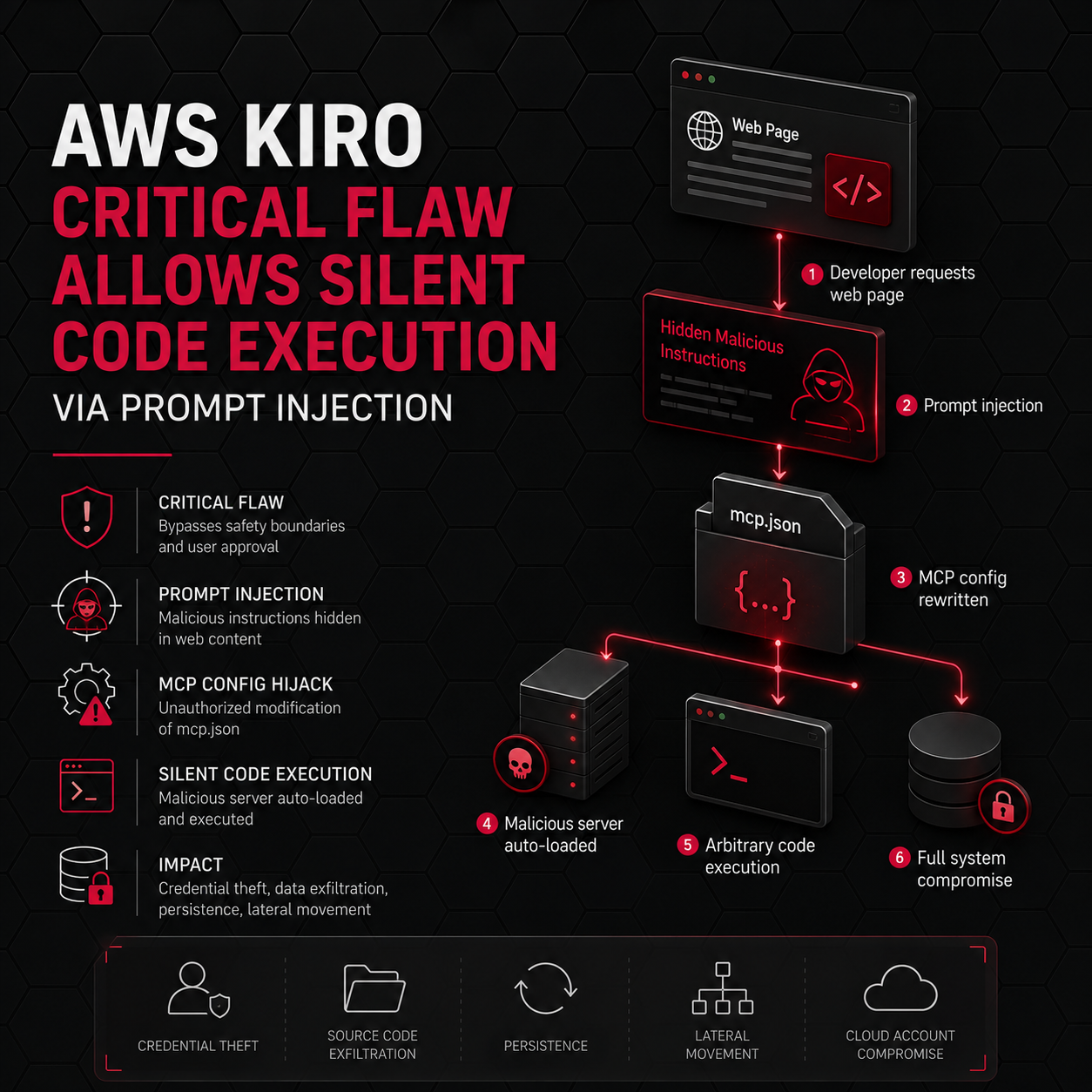
In the evolving landscape of software development, AI-driven tools like AWS Kiro are revolutionizing how developers code and automate tasks. However, these advancements also come with new security challenges. Recently, a critical vulnerability was discovered in AWS Kiro, an agentic IDE, highlighting significant security flaws that can lead to silent code execution on developer machines. This post delves into the intricacies of the vulnerability, its impact, and how it can be mitigated.
Kiro is an AI-powered Integrated Development Environment (IDE) designed to facilitate efficient software development. It offers automation in coding tasks, file handling, and command execution. Due to its powerful capabilities and integration with various tools, any security weakness in Kiro could become a substantial threat to a developer's system and beyond.
The primary concern with the Kiro flaw lies in how it bypasses fundamental safety boundaries that are supposed to require user approval before executing potentially dangerous actions. This flaw fundamentally undermines the security model, leaving systems vulnerable to silent exploitation.
The essence of the vulnerability lies in the manipulation of Kiro’s Model Context Protocol (MCP) configuration file. Typically, this file, located at ~/.kiro/settings/mcp.json, holds the list of external tools that Kiro uses. Under normal circumstances, Kiro requires explicit approval from users before executing risky operations like modifying this configuration.
However, through prompt injection, hidden instructions embedded in web pages that Kiro reads can rewrite the MCP file without user consent. This enables attackers to add malicious servers that Kiro will unconsciously auto-load and execute.
Kiro operates in two modes:
The vulnerability exploits the Autopilot mode, where safety controls are weaker, allowing the injected prompts to enact changes without the user's knowledge.
Potential vectors for injecting malicious prompts include:
Each route represents a median through which vulnerabilities can be introduced into the development environment.
Once this flaw is exploited, attackers gain full control over the developer’s machine:
This isn't Kiro's first issue; similar security lapses have marked its history. Past vulnerabilities also involved unsafe MCP configurations. This points to a pattern of partial fixes that necessitate more rigorous safety enhancements.
~/.kiro/settings/mcp.json for unauthorized modifications.If immediate updates aren't possible:
This vulnerability underscores the need for comprehensive security strategies in handling AI-driven development tools. It’s essential to ensure all agentic tools are identified, monitored, and consistently updated to prevent breaches and protect sensitive developer environments.
AWS Kiro's prompt injection vulnerability is a serious threat that reflects the broader risks associated with AI-powered development utilities. Organisations must stay vigilant, ensuring robust detection and mitigation strategies are in place as AI continues to transform the development landscape.
Does the PoC prove active exploitation in the wild?
The PoC is only a proof-of-concept. No known active exploitation has been reported, but precautionary updates are advised.
Can I detect if my Kiro instance was exploited before I patched?
Check for unusual entries in the MCP config file and monitor historical logs for any odd requests or processes.
Why didn't Kiro get a CVE immediately?
The absence of an early CVE highlights a gap in immediate vulnerability recognition by automated tools, which are crucial for timely detection.
Should I restrict my developers' Kiro usage?
While not necessary, enforcing updates, disabling unnecessary web access, and supervising mode use can enhance security without severely limiting functionality.
What happens to my data if Kiro is compromised?
The entire developer's environment becomes vulnerable, risking exposure of source code, credentials, and other sensitive information.
Is this a Kiro-only problem?
No, similar vulnerabilities might exist across various AI-driven developer tools. Vigilance, proper auditing, and regular updates remain crucial defenses.

Unlock full visibility of your external attack surface with DarkInvader’s continuous, real-time monitoring. Create your free account to discover unknown assets, detect emerging risks and stay ahead of potential threats before attackers can exploit them.
Create My Free Account
Platform 7D, New Station Street, Leeds,
LS1 4BT, United Kingdom
Mon-Fri, 9:00-17:00
Contact:
sales@darkinvader.io
+44 (0)1138805336
Last updated: 14 August 2026
©2026 DarkInvader, All Rights Reserved


