


Every organisation has an external attack surface: the domains, subdomains, IP addresses, cloud services, login pages and third-party platforms that anyone on the internet can reach. Most organisations also have parts of that surface they don’t know about. A forgotten staging server, a campaign microsite an agency built three years ago, a storage bucket someone made public for a day and never closed.
External attack surface management (EASM) is the practice of finding those assets from the outside in, the way an attacker would, then monitoring them continuously and flagging the exposures that matter. It differs from traditional vulnerability management in one important way: it doesn’t start from your asset list. It starts from the internet and works back towards you.
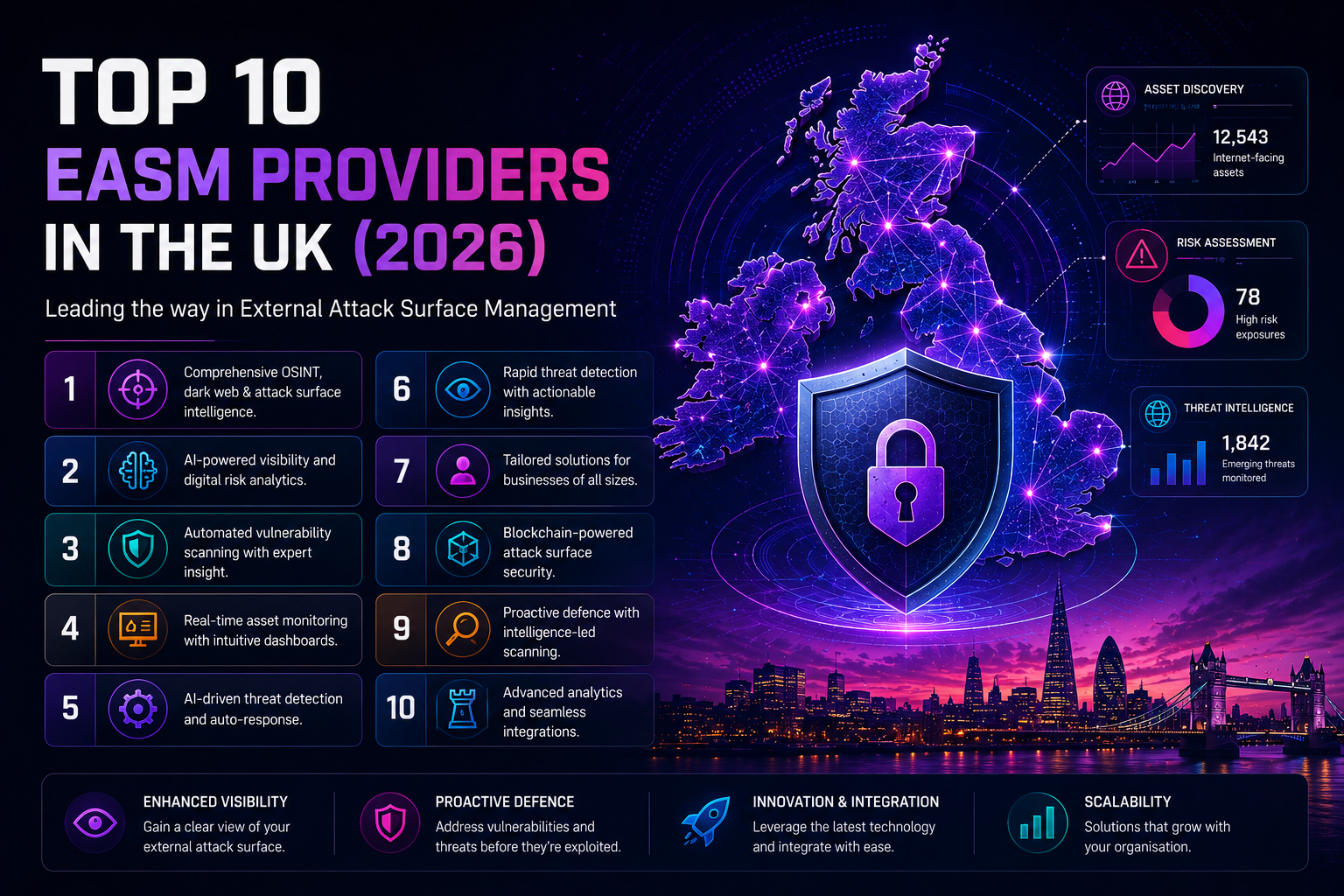
This guide looks at ten real EASM providers that UK organisations can buy from in 2026. One of them is DarkInvader, which is our own platform, and we say so plainly where it appears. The rest are described as fairly and factually as we can, based on what each vendor publishes about its own product. We haven’t ranked them, because the right choice depends on your estate, your team and what you already run.
Why UK organisations need EASM
Your attack surface changes every week. Cloud platforms let teams create public-facing services in minutes. Marketing campaigns, supplier portals, acquisitions and staff turnover all add assets that never pass through a change process. An annual penetration test or a quarterly scan scoped from your CMDB only ever tests what you already knew about.
There’s also a regulatory and supply chain angle. UK organisations in regulated sectors, and the suppliers that serve them, are being asked harder questions about how they know what they expose and how quickly they find out when it changes. Continuous external visibility is one of the more practical ways to answer those questions with evidence rather than a policy document.
How we chose these providers
We included vendors that meet all of the following:
- A real, current EASM capability: the product discovers internet-facing assets an organisation hasn’t declared and monitors them over time, not just scans a supplied list.
- Available to UK buyers: either UK-based, with a UK office, or selling to UK organisations directly or through partners.
- Verifiable: we could confirm the product name and what it does from the vendor’s own published material as of 2026.
We didn’t include pricing, customer numbers or analyst rankings. These change often, vary by contract and are best confirmed directly with each vendor. The order below isn’t a ranking.
10 EASM providers for UK organisations in 2026
1. DarkInvader (our platform)
What it is: DarkInvader is the platform behind this blog, so read this entry with that in mind. It combines continuous external reconnaissance with asset discovery, asset monitoring and vulnerability scanning, alongside dark web, Telegram and OSINT monitoring and leaked credential detection.
Strengths: it goes beyond infrastructure into people and suppliers, with supplier and third-party risk management, brand, people and VIP monitoring, and website takedowns. Nyx, an AI security consultant, helps teams understand their risks, and a human Research Team sits behind the platform. Management reports, integrations, a client-facing API and an MCP connector support day-to-day workflows.
Worth knowing: DarkInvader verifies domain ownership before running monitored scans, so expect a short verification step during onboarding.
Best for: organisations that want external assets, leaked credentials, supplier exposure and brand or executive risk in one view.
UK presence: based in Leeds.
2. Intruder
What it is: Intruder is a cloud-based platform combining attack surface management with continuous vulnerability scanning across infrastructure, web applications and cloud environments.
Strengths: Intruder says its attack surface management discovers subdomains, login pages, APIs and exposed services, and can connect to AWS, Google Cloud, Azure and Cloudflare accounts to scan new services when they appear. Change detection triggers scans when the perimeter changes.
Worth knowing: its focus is vulnerability and exposure management. Dark web, brand and supplier monitoring aren’t its core.
Best for: teams that want a vulnerability-led approach with attack surface discovery built in.
UK presence: founded in 2015 and headquartered in London.
3. Outpost24
What it is: Outpost24 offers a cloud-based EASM platform that identifies and monitors known and unknown internet-facing assets. Its CyberFlex offering combines attack surface management with penetration testing as a service (PTaaS).
Strengths: pairing automated discovery with human-led application testing means findings on critical web applications can be followed up by testers.
Worth knowing: Outpost24 sells a broader exposure management portfolio, so be clear which modules you need when scoping.
Best for: organisations that want EASM and application pentesting from the same supplier.
UK presence: headquartered in Sweden, with UK offices.
4. Detectify
What it is: Detectify has two main products. Surface Monitoring continuously discovers domains, subdomains, IPs and technologies and runs payload-based tests as assets appear. Application Scanning provides deeper, authenticated dynamic testing of web applications.
Strengths: its testing draws on research from a community of ethical hackers through its Crowdsource programme, with an emphasis on proving what’s exploitable rather than relying only on CVE matching.
Worth knowing: it’s web-application centric. If your concern is mainly network services or the dark web, check coverage carefully.
Best for: organisations with large web and application estates.
UK presence: headquartered in Stockholm, with a US office in Boston. We couldn’t find a UK office, so ask about UK support arrangements.
5. Hadrian
What it is: Hadrian describes itself as an agentic AI offensive security platform. Atlas provides continuous external exposure management, and Nova provides on-demand agentic pentesting for applications.
Strengths: the focus is on testing discovered assets the way an attacker would, to validate which exposures are real.
Worth knowing: active, autonomous testing needs clear rules of engagement agreed with your team and any hosting providers.
Best for: organisations that want automated offensive validation alongside discovery.
UK presence: headquartered in Amsterdam, with an office in London.
6. CyCognito
What it is: CyCognito positions its platform around exposure management, combining attack surface discovery with automated security testing and prioritisation.
Strengths: CyCognito says its discovery works without needing a supplied asset list and attributes assets to business units and subsidiaries, which suits complex corporate structures. It integrates with tools such as ServiceNow, Splunk and Jira.
Worth knowing: it’s aimed largely at large enterprises.
Best for: groups with many subsidiaries, brands or acquisitions to map.
UK presence: headquartered in Palo Alto, California, and sold in Europe through distribution partners.
7. Microsoft Defender External Attack Surface Management
What it is: Microsoft Defender EASM runs as an Azure resource. It starts from “discovery seeds”, such as known domains and IP blocks, and recursively finds connected infrastructure, building an inventory of domains, hosts, IP blocks, ASNs and related records.
Strengths: for Microsoft-centric organisations, it’s bought and managed through Azure, with dashboards covering vulnerabilities, compliance and security hygiene. Microsoft documents a 30-day free trial.
Worth knowing: at the time of writing, Microsoft’s list of supported regions for the resource doesn’t include UK South or UK West. If UK data residency matters, check current availability.
Best for: teams already working in Azure and the Microsoft security stack.
UK presence: Microsoft has a long-established UK operation.
8. Palo Alto Networks Cortex Xpanse
What it is: Cortex Xpanse is Palo Alto Networks’ attack surface management product. It scans the public internet to discover connected assets and exposed services, and uses machine learning to attribute them to your organisation.
Strengths: it sits within the wider Cortex platform, where Palo Alto Networks also offers Cortex Exposure Management, bringing external, cloud, network and endpoint findings together. Recent releases add attack surface testing to confirm findings.
Worth knowing: it’s an enterprise product and fits best where Cortex tooling is already in place.
Best for: large organisations standardising on Palo Alto Networks.
UK presence: Palo Alto Networks has its UK headquarters in London.
9. CrowdStrike Falcon Exposure Management
What it is: CrowdStrike’s EASM capability is part of Falcon Exposure Management. It grew from CrowdStrike’s 2022 acquisition of Reposify and was previously sold as Falcon Surface.
Strengths: CrowdStrike says it scans the internet continuously to find exposed assets, including shadow IT, and prioritises exposures using adversary-driven insights from its threat intelligence. It connects with the rest of the Falcon platform.
Worth knowing: the value is greatest for organisations already running Falcon.
Best for: existing CrowdStrike customers who want internal and external exposure in one console.
UK presence: CrowdStrike has UK offices, including Reading.
10. Censys
What it is: Censys started as a research project at the University of Michigan and is known for its internet-wide scanning data. Its attack surface management offering uses that map to discover and monitor an organisation’s exposed assets.
Strengths: Censys says it scans across all 65,000 ports, including non-standard ones, and alerts on changes such as new hosts, services and certificates. Its data is also used for threat hunting and research.
Worth knowing: it’s data-rich, so plan for the analyst time needed to make the most of it.
Best for: security teams that want deep internet data and investigation capability.
UK presence: headquartered in Ann Arbor, Michigan, with EMEA staff based in the UK.
What to look for in an EASM platform
Feature lists overlap heavily, so compare providers on how they work rather than what they claim:
- Discovery method: does it find assets you haven’t told it about, and how does it decide they belong to you?
- Change detection: how quickly does a new subdomain, open port or certificate appear in the platform?
- Testing depth: passive fingerprinting, active vulnerability scanning or exploit validation? Each has a different noise and risk profile.
- Coverage beyond infrastructure: leaked credentials, dark web mentions, supplier exposure and brand impersonation are part of the external picture too.
- Deduplication and prioritisation: will analysts trust the feed, or start ignoring it?
- Integrations: can findings reach Jira, ServiceNow, Slack, Teams or your SIEM without manual copying?
- Data handling: where is data stored, and does that meet your UK residency needs?
How to choose
Start with what you already run. If most of your security stack comes from one vendor, its EASM module may be the simplest fit. If you want a dedicated platform, shortlist two or three and run them against your own estate.
During a trial, compare the discovered asset list with your inventory. The interesting results are the assets you didn’t know about. Then look at a week’s worth of changes and ask whether your team could act on them in a twenty-minute weekly review.
Finally, ask each vendor four questions: how do you discover assets we haven’t declared, how do you deduplicate findings, how do you attribute a leaked credential to an asset and an owner, and what does a normal week of alerts look like?
Frequently asked questions
What is the difference between EASM and vulnerability scanning?
Vulnerability scanning tests a list of assets you supply. EASM discovers what’s actually exposed on the internet, including assets missing from that list, and monitors it continuously. Many EASM platforms include scanning, but discovery comes first.
Do UK organisations need a UK-based EASM provider?
Not necessarily. What matters more is where your data is stored, how support works in your time zone and whether the vendor meets your procurement requirements. Check data residency and contract terms directly with each provider.
How long does it take to see results from EASM?
Discovery usually starts from little more than a domain or organisation name, so an initial asset inventory tends to arrive early in a trial. The ongoing value comes from change detection over the following weeks, as new assets and exposures appear.
Is EASM only for large enterprises?
No. Smaller organisations often have less visibility of their external footprint, not more. The useful test is whether a platform’s alerts are manageable for the size of your team, so trial before you commit.
If you’d like to see what DarkInvader finds on your own estate, you can Start Free Trial and compare the results with your current inventory.