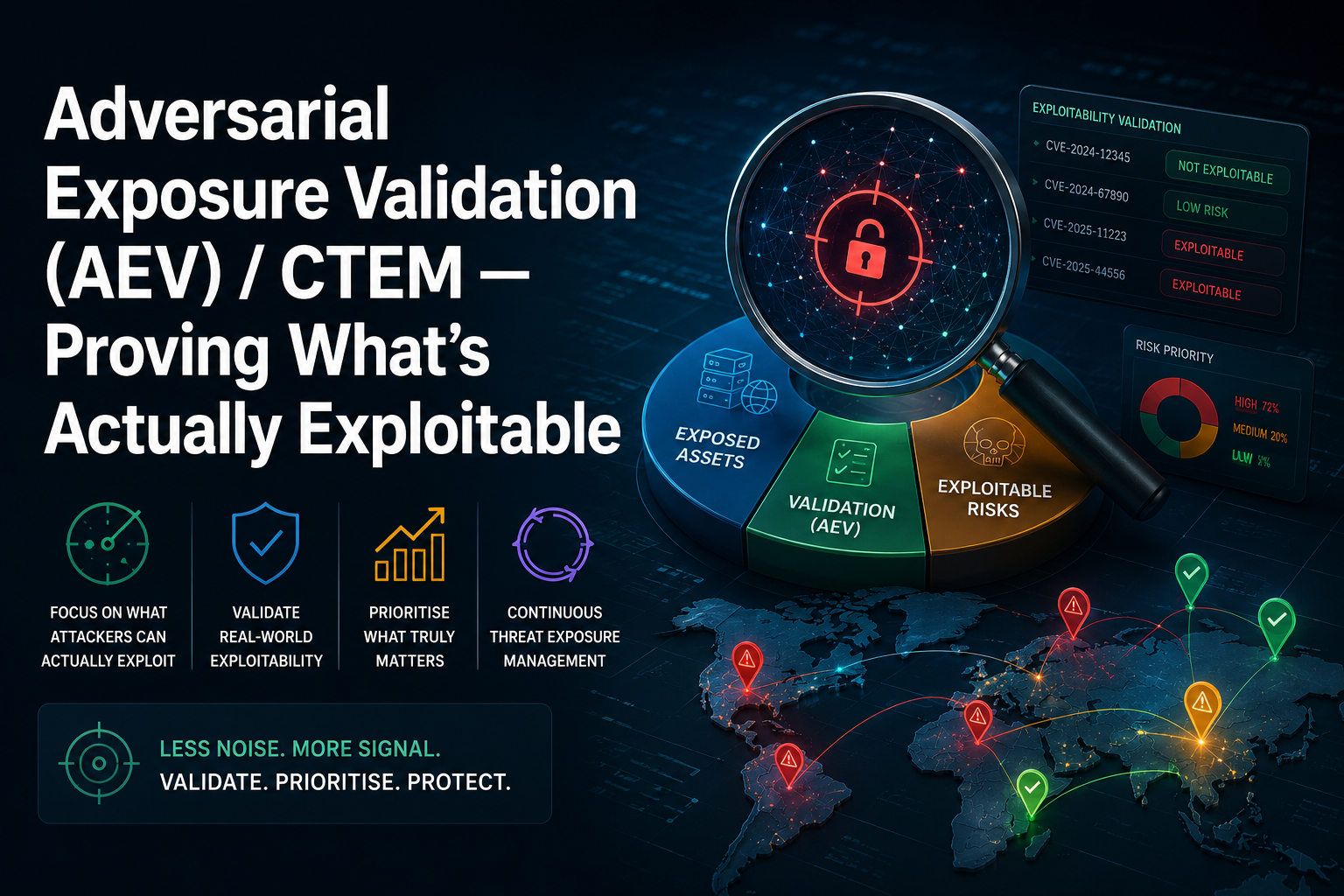
In the dynamic world of cybersecurity, organisations are inundated with information about vulnerabilities. However, visibility alone no longer suffices. The focus has shifted towards validating what is truly exploitable to prioritize defence efforts effectively. This is where Adversarial Exposure Validation (AEV) as a pillar of Continuous Threat Exposure Management (CTEM) becomes essential.
Traditionally, security teams relied heavily on visibility to understand potential threats. While identifying vulnerabilities is crucial, not all vulnerabilities pose the same level of threat. AEV is designed to discern genuine risks, emphasizing real exploitability over theoretical concerns.
Adversarial Exposure Validation (AEV) is a method focused on assessing the real-world impact of vulnerabilities. It aims to move beyond raw CVSS scores and individual vulnerability assessments by examining actual exploit scenarios. This prioritization enables security teams to address the vulnerabilities that present the highest risk.
Incorporating validation into the vulnerability management process enhances risk management. By focusing on what can be exploited effectively, resources are allocated more efficiently, reducing wasteful security spending.
AEV improves security operations by concentrating on genuine threats, thereby enhancing the overall protection framework. It ensures that defences are responsive and relevant to actual risks.
Continuous Threat Exposure Management (CTEM) is a comprehensive approach to managing cyber threats, continuously assessing and responding to vulnerabilities. AEV serves as the validation component, ensuring that CTEM is effective and aligned with organisational priorities.
Gartner’s framework for CTEM highlights the importance of validating exploitability. By aligning security efforts with reliable validation, businesses can achieve more precise and impactful threat exposure management.
Adopting AEV requires a strategic approach:
A BreachLock contributed article illustrates how focusing on exploitability fosters a security culture resilient to emerging threats. By employing a methodology centered on validation, organisations can adapt and respond more effectively.
Adversarial Exposure Validation (AEV) reflects the shift from visibility to validation within security strategies. It’s a necessary advancement in line with modern threats and remains integral to Continuous Threat Exposure Management (CTEM). By concentrating on actual exploitability, security teams are empowered to protect their organisations more effectively.
AEV is a method in cybersecurity focusing on validating real-world exploitability of vulnerabilities rather than relying solely on visibility measures and CVSS scores.
AEV connects with Continuous Threat Exposure Management by providing the validation pillar, ensuring that exposure management is both comprehensive and focused on true risks.
Validation focuses security resources on actual threats, enhancing efficiency and effectiveness by addressing vulnerabilities that can be exploited in real environments.
By embracing Adversarial Exposure Validation, organisations fortify their cyber defences, gearing up against the true challenges of modern cybersecurity threats.

Unlock full visibility of your external attack surface with DarkInvader’s continuous, real-time monitoring. Create your free account to discover unknown assets, detect emerging risks and stay ahead of potential threats before attackers can exploit them.
Create My Free Account
Platform 7D, New Station Street, Leeds,
LS1 4BT, United Kingdom
Mon-Fri, 9:00-17:00
Contact:
sales@darkinvader.io
+44 (0)1138805336
Last updated: 14 August 2026
©2026 DarkInvader, All Rights Reserved


