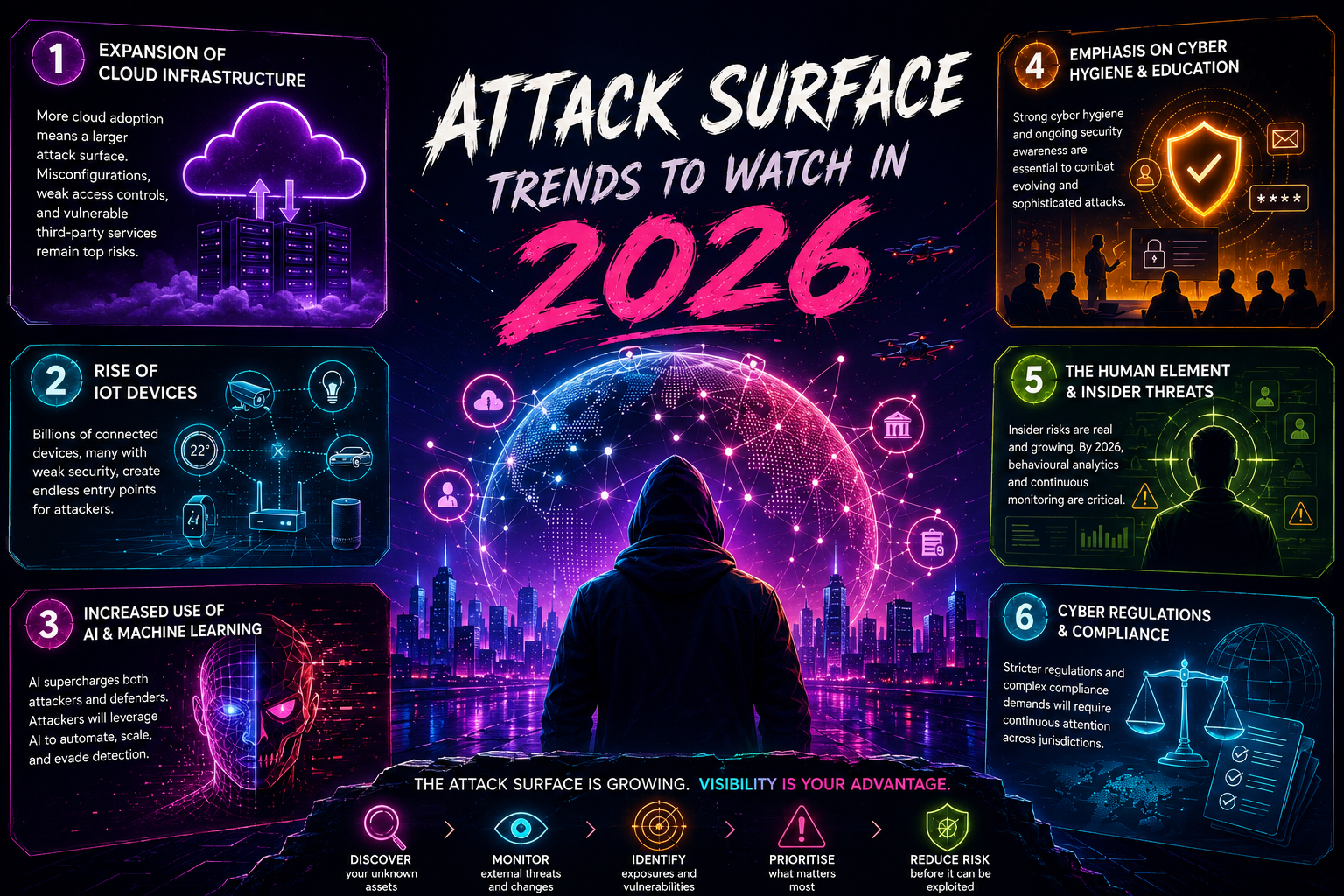
As the cyber threat landscape continues to evolve, understanding the attack surface trends for 2026 is more critical than ever. With the increasing digitisation of businesses and personal lives, threat actors are constantly adapting to new security measures and technologies. This blog post will explore the trends that are likely to shape the attack surface and the necessary measures businesses need to adopt to stay ahead of potential threats.
The attack surface refers to the sum of different points—digital and physical—where an unauthorised user can try to access data. This includes endpoints, data centres, applications, networks, and user vulnerabilities. Managing the attack surface involves minimising potential entry points and continuously monitoring and mitigating any vulnerabilities that arise.
For more information on managing this, DarkInvader's OSINT Monitoring offers a comprehensive solution to keep your digital assets monitored and secure from potential threats.
By 2026, the reliance on cloud services is expected to increase substantially. This expansion comes with a corresponding increase in the attack surface. As businesses migrate more operations to the cloud, the scope for misconfigurations, inadequate access controls, and vulnerabilities in third-party cloud applications also rises.
The Internet of Things (IoT) is creating a vast network of connected devices, each potentially exposing new vulnerabilities. From smart homes to autonomous vehicles, the security of IoT devices is crucial; yet, many of these devices lack strong security controls.
AI and machine learning technologies are revolutionising cybersecurity defences but are also being exploited by cybercriminals. The use of AI by attackers to automate and enhance their attack strategies will become more prevalent by 2026.
Cyber hygiene—basic security practices like updating software, using strong passwords, and recognising phishing attempts—will remain a key line of defence. As attack vectors become more sophisticated, regular employee training and awareness campaigns will be essential components of a robust security posture.
DarkInvader's Vulnerability Scanning helps organisations proactively identify and address vulnerabilities in their systems, enhancing overall cyber hygiene.
Despite technological advances, humans remain one of the weakest links in cybersecurity. Insider threats, whether malicious or accidental, pose a significant risk to organisations. By 2026, businesses will need to focus heavily on behavioural analytics and continuous monitoring to manage this aspect of their attack surface effectively.
With increasing cyber threats, regulatory bodies worldwide are tightening compliance requirements. By 2026, the landscape of cyber regulations will be more complex and demanding, requiring organisations to stay updated on and adhere to various international laws and standards.
Companies will benefit from engaging with experts or using services like DarkInvader’s Third-Party Integrations to ensure compliance across different jurisdictions.
The cyber threat landscape is continually evolving, and by 2026, several key trends will shape the attack surface. Staying informed and proactive is essential for organisations to protect their assets and ensure long-term success. From embracing advanced technologies to fostering a culture of security awareness, businesses that adapt to these trends will be better positioned to face the challenges of the coming years.

Unlock full visibility of your external attack surface with DarkInvader’s continuous, real-time monitoring. Create your free account to discover unknown assets, detect emerging risks and stay ahead of potential threats before attackers can exploit them.
Create My Free Account
Platform 7D, New Station Street, Leeds,
LS1 4BT, United Kingdom
Mon-Fri, 9:00-17:00
Contact:
sales@darkinvader.io
+44 (0)1138805336
Last updated: 14 August 2026
©2026 DarkInvader, All Rights Reserved


