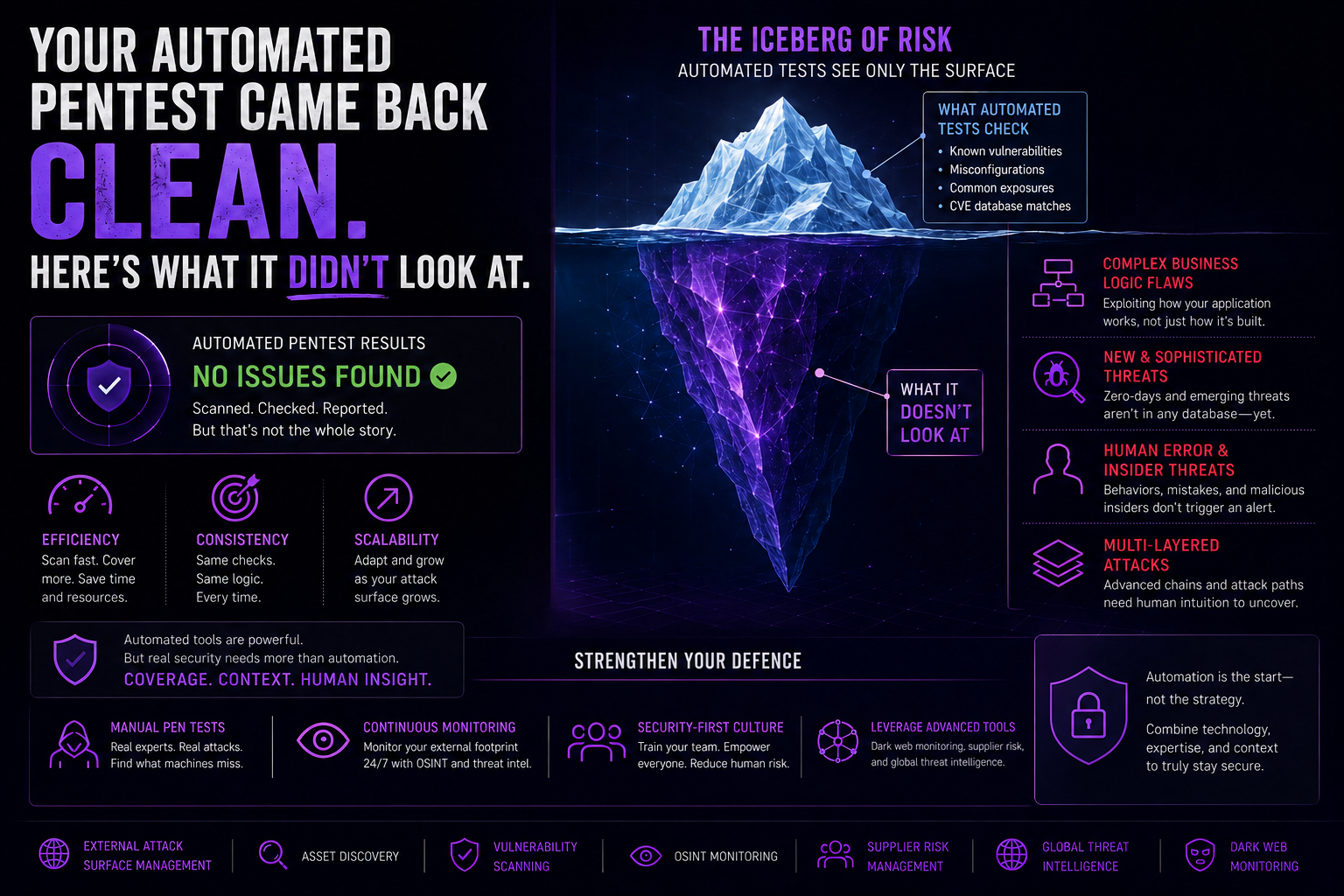
In today's digital landscape, cybersecurity remains at the forefront of every business discussion. With increasingly sophisticated attacks, companies often turn to automated penetration testing to evaluate their security perimeter. Seeing results come back clear fills many with relief, but it doesn't mean all potential risks have been addressed. Automated tests have their limitations, and understanding their scope is crucial in bolstering comprehensive security strategies.
Automated penetration testing, often referred to as autopentesting, leverages software to simulate cyberattacks on your network. These tools scan systems for vulnerabilities and produce reports on potential weaknesses. They provide a cost-effective, quick overview of some threats your systems might face.
For more information on vulnerability scanning, visit our Vulnerability Scanning page.
Despite their strengths, automated tests are not infallible and might overlook critical areas:
Automated tools excel at identifying known vulnerabilities but struggle with exploiting flaws related to business logic, where an application's workflow can be manipulated to gain unauthorised access. These nuanced vulnerabilities require an understanding of the application context, which is beyond the scope of most automated tools.
Cyber threats continually evolve, and automated tools often rely on existing databases of known vulnerabilities. Zero-day exploits, which are newly discovered weaknesses without a known fix, can go undetected until they are manually identified.
An automated tool can't assess human behaviour within your organisation. Insider threats, whether malicious or accidental, often go unnoticed by automated systems. These require vigilant monitoring and an understanding of employee behaviours.
Cyberattacks are increasingly sophisticated, employing multi-layered tactics that automated tests might not replicate or interpret correctly. Complex threat vectors often overlap, requiring advanced analytical skills to uncover.
While technology is at the heart of cybersecurity, human expertise is irreplaceable. Skilled professionals excel in:
For insights on threat intelligence, consider DarkInvader's Global Threat Intelligence.
To ensure comprehensive security, companies must integrate automated testing with manual processes. Here’s how:
While automated tools offer immediate insights, regular manual pen tests can identify overlooked vulnerabilities. Collaborate with experienced professionals to simulate real-world attacks tailored to your company's unique environment.
Constant vigilance is key. Tools like DarkInvader’s OSINT Monitoring allow businesses to observe changes across public and private domains, ensuring emerging threats are detected promptly.
Encourage a culture where security is everybody’s responsibility. Provide regular training sessions that empower employees to recognise and counter potential threats proactively.
Advanced monitoring tools, such as those focusing on dark web activities, offer insights into potential leaks and breaches within underground venues.
While an automated pentest showing no visible issues can bring relief, it shouldn't foster complacency. Comprehensively securing your organisation requires an intricate blend of technology, human intelligence, and ongoing vigilance. Partnering advanced tools with experienced cybersecurity professionals ensures a robust line of defence against emerging threats.
What is automated penetration testing?
Automated penetration testing uses software tools to simulate cyberattacks, evaluating a network's security by scanning systems for known vulnerabilities.
Are automated pentests sufficient for comprehensive security?
No, automated tests should be part of a broader security strategy. They may miss complex vulnerabilities, new and sophisticated threats, and insider risks, requiring manual oversight.
How can businesses address the limitations of automated pentests?
Incorporate regular manual testing, continuous monitoring, and foster a security-conscious culture to enhance automated solutions. Advanced tools and human expertise are crucial.
What role do humans play in cybersecurity?
Humans provide the creativity, context, and insight that technology alone cannot. Professionals can identify complex threats and devise innovative strategies to counteract them.
For further information on monitoring and managing cybersecurity risks, explore our Supplier Risk Management page.

Unlock full visibility of your external attack surface with DarkInvader’s continuous, real-time monitoring. Create your free account to discover unknown assets, detect emerging risks and stay ahead of potential threats before attackers can exploit them.
Create My Free Account
Platform 7D, New Station Street, Leeds,
LS1 4BT, United Kingdom
Mon-Fri, 9:00-17:00
Contact:
sales@darkinvader.io
+44 (0)1138805336
Last updated: 14 August 2026
©2026 DarkInvader, All Rights Reserved


