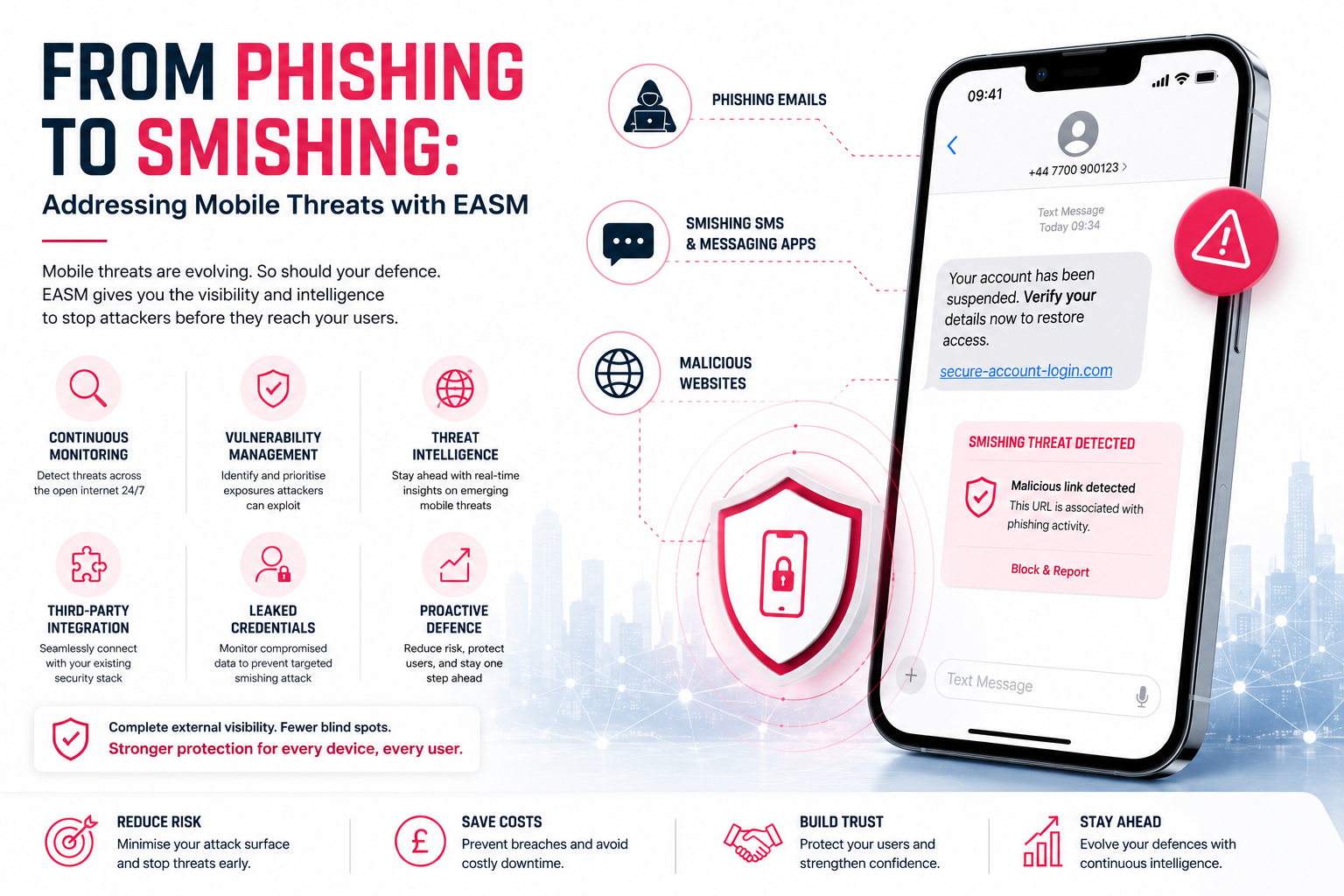
In today's digital ecosystem, our reliance on mobile devices is at an all-time high. Whether for personal communication, business transactions, or routine browsing, the mobile phone has become a central tool in our daily lives. However, this surge in mobile usage has not gone unnoticed by cybercriminals. As traditional phishing schemes have started to target mobile devices, a more sinister form has emerged: smishing. This article will explore the evolution of these threats and how External Attack Surface Management (EASM) can be a robust solution to protect against these mobile threats.
Phishing is a well-known cyberattack that uses disguised emails to trick individuals into revealing sensitive information. Traditional phishing attacks are often executed through email, where attackers pretend to be reputable organisations. Despite its long history, phishing remains a popular technique due to its effectiveness.
As mobile phones became ubiquitous, so too did mobile phishing, popularly known as "smishing" (SMS phishing). Unlike traditional phishing emails, smishing attacks utilise SMS or messaging apps to deploy similar deceptive tactics. The immediacy and personal nature of text messages can often make smishing more effective, with users frequently clicking on malicious links or responding to fraudulent requests for personal information.
External Attack Surface Management (EASM) is a proactive security measure designed to identify, monitor, and manage potential security risks on the external front of an organisation's digital assets. By continuously monitoring the internet, EASM can pinpoint vulnerabilities and exposed data, helping organisations to address threats before they can be exploited.
EASM plays a crucial role in protecting against mobile threats by:
As we shift further into mobile-first digital environments, the threat landscape continues to evolve. Smishing represents just one of the many attack vectors that threaten our mobile devices daily. By leveraging EASM, organisations can not only shield themselves from these mobile-specific threats but also provide an all-encompassing safeguard for all digital interactions.
Investment in solutions like EASM is paramount for maintaining robust security and ensuring our mobile-age information is safeguarded against increasingly sophisticated attacks.
Smishing, or SMS phishing, is a form of cyberattack where attackers use text messages to mislead victims into exposing personal information. Unlike traditional phishing, smishing leverages the immediacy and perceived trustworthiness of SMS communication.
EASM protects against mobile threats by continuously monitoring vulnerabilities and threats, providing real-time insights and proactive risk mitigation strategies. It ensures that organisations can address security issues before they are exploited.
EASM is crucial for cybersecurity as it offers a proactive approach to managing digital exposure. By identifying potential threats and vulnerabilities before they can be exploited, EASM helps in safeguarding data and maintaining operational integrity.
Yes, many EASM solutions are designed to integrate seamlessly with existing security architectures. This integration enhances the overall security posture without necessitating a complete overhaul of current systems.

Unlock full visibility of your external attack surface with DarkInvader’s continuous, real-time monitoring. Create your free account to discover unknown assets, detect emerging risks and stay ahead of potential threats before attackers can exploit them.
Create My Free Account
Platform 7D, New Station Street, Leeds,
LS1 4BT, United Kingdom
Mon-Fri, 9:00-17:00
Contact:
sales@darkinvader.io
+44 (0)1138805336
Last updated: 14 August 2026
©2026 DarkInvader, All Rights Reserved


