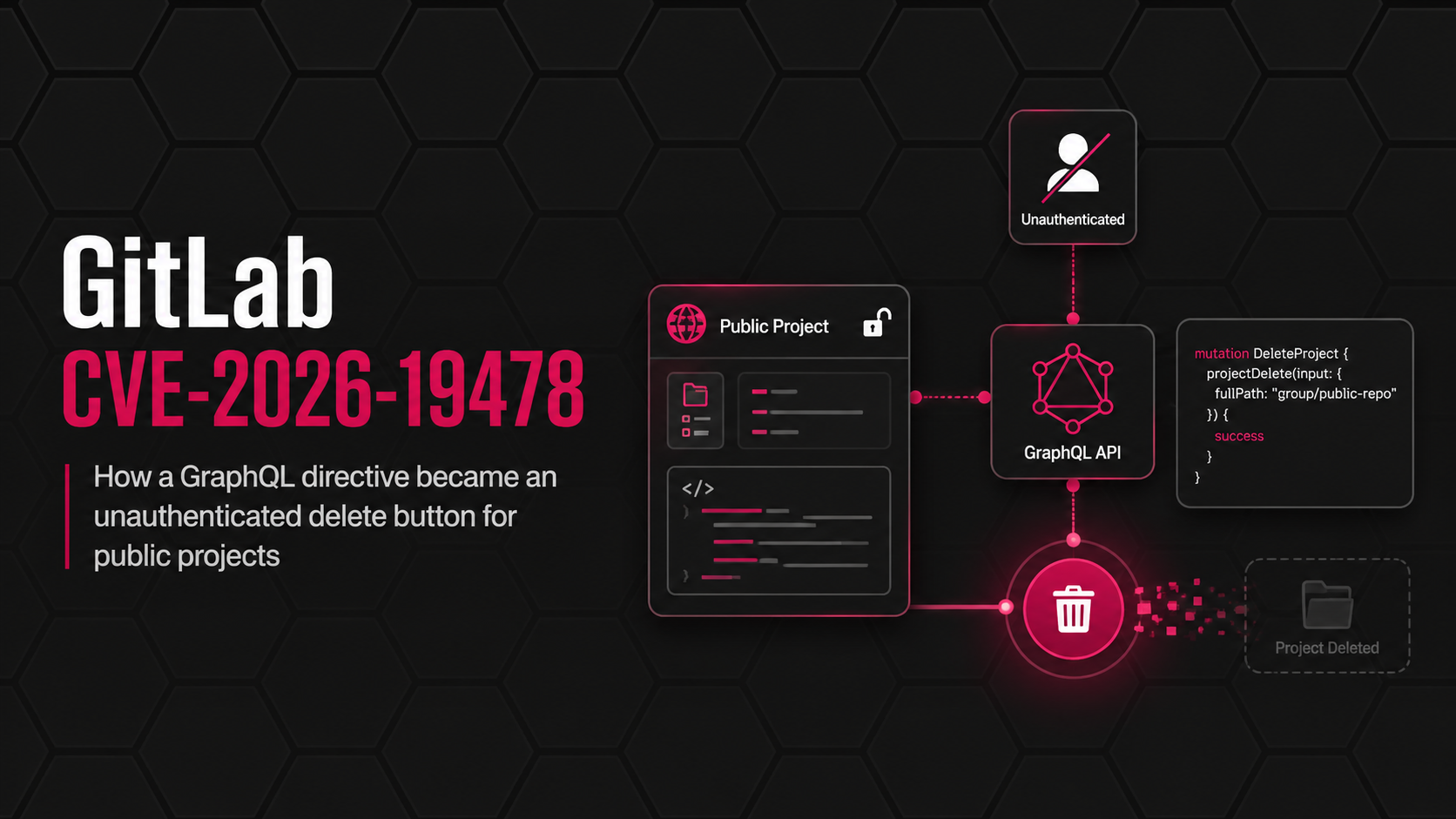
In short: CVE-2026-19478 is a critical code injection vulnerability affecting GitLab. Rated 9.4, it allows unauthenticated deletion of public projects. GitLab has issued patches for affected versions, and exploitation has been confirmed.
CVE-2026-19478 is a code injection vulnerability in GitLab Community and Enterprise Editions. Rated 9.4 on the CVSS 3.1 scale, this vulnerability allows unauthenticated attackers to remotely modify or delete public projects and user data using a GraphQL directive. The high score reflects the ease of exploitation: no credentials, privileges, or user interaction are required, leading to potential widespread disruption.
The vulnerability affects GitLab versions 18.2 through 18.11.10, 19.0 through 19.0.7, 19.1 through 19.1.5, and 19.2 through 19.2.3. GitLab released fixed versions 18.11.11, 19.0.8, 19.1.6, and 19.2.4 on 17 August 2026. The table below summarizes the affected and fixed versions.
Exploitation began rapidly following the 17 August 2026 disclosure. Security company watchTowr reproduced the vulnerability within minutes by analyzing the advisory against the patch diff. Within two days, exploitation attempts were observed against its Attacker Eye honeypot network, confirming the swift exploitation timeline.
An attacker exploiting CVE-2026-19478 can modify or delete public GitLab projects without authentication. This allows them to manipulate or remove source code, disrupt collaborative efforts, and potentially inject malicious code into repositories. The impact can range from minor disruptions to significant harm, depending on the project's nature and prominence.
GitLab.com's hosted instances are already patched. However, self-managed GitLab instances require action from the users. Without immediate patching, these instances remain vulnerable, making them the real exposure point for attacks. Self-managed teams must prioritize patching or apply interim mitigations to safeguard their environments.
Utilizing continuous external attack surface discovery tools can help identify exposed GitLab instances. Conduct an inventory of all self-managed installations, ensuring they are updated and not publicly accessible without necessary configurations. Regular audits and vulnerability scanning further help in finding exposed assets.
If immediate patching isn't feasible, restrict unauthenticated access to the /api/graphql endpoint. Alternatively, temporarily removing public repository access can serve as a mitigation measure. Monitoring network traffic and implementing IP whitelisting can also reduce potential exposure until patching is achieved.
The fast exploitation of CVE-2026-19478 underscores the importance of minimising the patch-to-exploit window. Organisations must rapidly apply security updates and monitor for known vulnerabilities to prevent exploitation. Effective asset monitoring can alert teams to vulnerabilities, enabling swift action.
What is CVE-2026-19478?
CVE-2026-19478 is a critical vulnerability in GitLab that allows unauthenticated deletion of public projects through improper control of code generation.
How are GitLab.com instances protected?
GitLab.com instances were patched by GitLab, leaving only self-managed instances vulnerable until patched by users.
What can be done if patching isn't immediately possible?
Restrict access to the /api/graphql endpoint or remove public repository access temporarily to prevent exploitation.
Why are GraphQL vulnerabilities dangerous?
GraphQL's flexibility can lead to security challenges if directives are improperly configured, as seen with CVE-2026-19478.
How do I ensure my GitLab is secure?
Regular updates, shadow IT detection, and vulnerability scanning are key to securing GitLab instances.
What tools can assist in preventing such incidents?
Continuous external attack surface discovery and OSINT monitoring are effective tools in mitigating security threats.
The GitLab CVE-2026-19478 incident highlights the imperative need for visibility into exposed developer infrastructure. Regular updates, robust monitoring, and attack surface management are crucial. By understanding this incident, DevSecOps leads and engineers can better prepare for and prevent future vulnerabilities.

Unlock full visibility of your external attack surface with DarkInvader’s continuous, real-time monitoring. Create your free account to discover unknown assets, detect emerging risks and stay ahead of potential threats before attackers can exploit them.
Create My Free Account
Platform 7D, New Station Street, Leeds,
LS1 4BT, United Kingdom
Mon-Fri, 9:00-17:00
Contact:
sales@darkinvader.io
+44 (0)1138805336
Last updated: 14 August 2026
©2026 DarkInvader, All Rights Reserved


