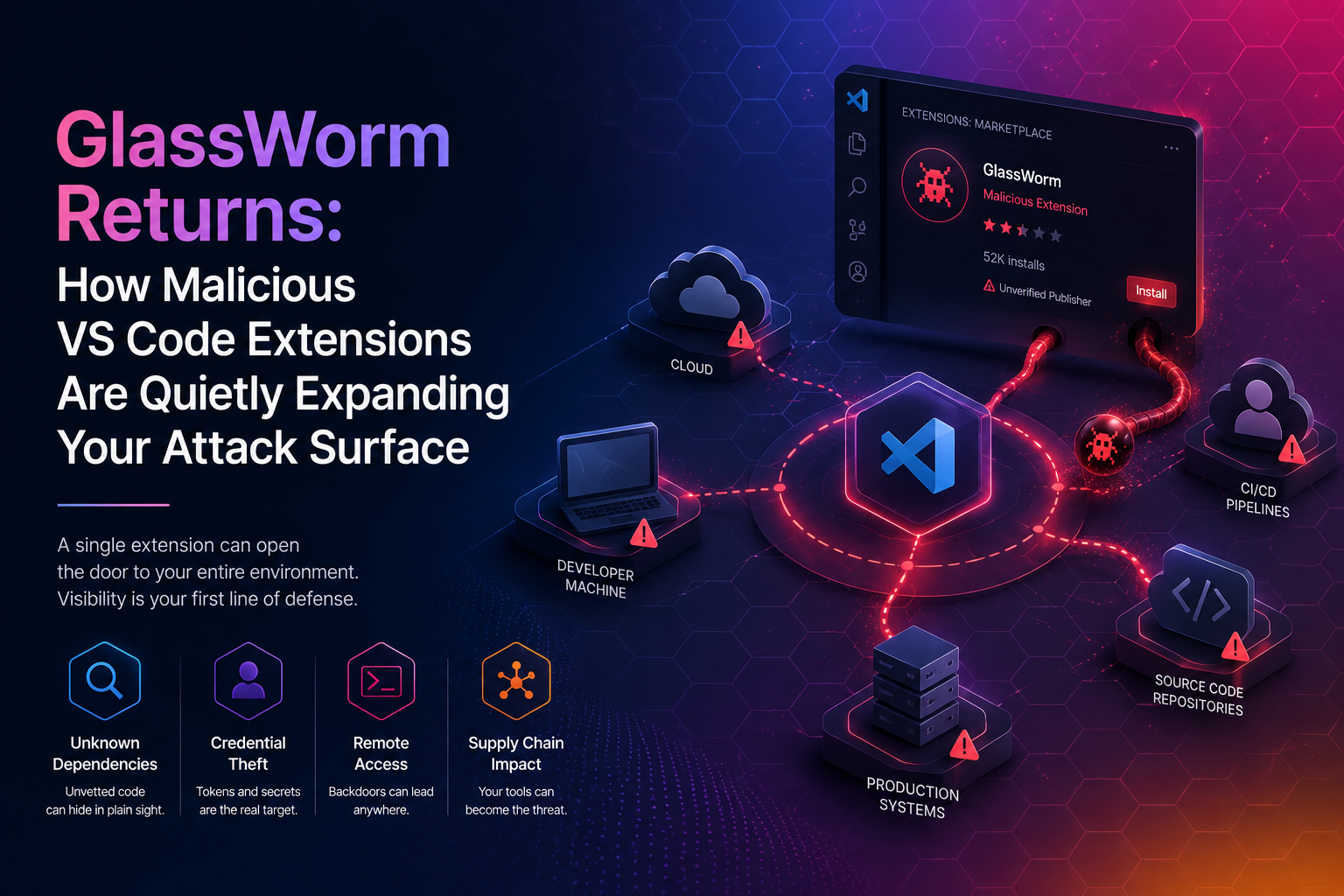
In today’s rapidly evolving digital landscape, cybersecurity threats are becoming increasingly sophisticated. One such emerging threat is the resurgence of GlassWorm, a notorious set of malicious VS Code extensions. This blog delves into how this particular supply chain attack is expanding attack surfaces and why it's catching security leaders and DevSecOps teams off guard.
GlassWorm refers to a series of malicious extensions for Visual Studio Code (VS Code), a widely used code editor. These extensions, once installed, can operate with the same permissions as the developer, accessing critical assets such as credentials, source code, and cloud infrastructures. This poses a significant risk as it can lead to unauthorized data access and manipulation.
VS Code extensions are underrated as an attack vector primarily because developer environments are considered somewhat isolated. However, these environments often hold sensitive information, having access to various cloud environments and critical repositories. This access, when exploited, makes malicious extensions potent tools for expanding an organisation's external attack surface.
Compromised extensions push the boundaries of your traditional attack surface management. Developer workstations housing these extensions can connect to internal APIs, remote servers, and more. As such, they inadvertently become gateways for attackers to infiltrate systems beyond the traditional perimeter.
Traditional security solutions, such as endpoint detection and response (EDR) and static scanners, often fall short in detecting these types of threats. EDRs may not flag such extensions if they do not perform any overt malicious action immediately post-installation. Moreover, static scanners may not thoroughly vet extensions from trusted markets.
GlassWorm represents a series of malicious extensions for VS Code intended to access sensitive developer resources covertly.
They often have access to critical developer resources like source code and cloud credentials, making them potential vectors for expanded attack surfaces.
They provide attackers pathways beyond traditional boundaries, tapping into developer machines that interface with broader systems and networks.
No, traditional EDRs and scanners may not detect these threats unless there's immediate visible malicious activity.
By performing regular audits of VS Code extensions, educating developers, and using behavioural analysis tools to detect deviations from normal operations.
CTA: Discover hidden exposures across your developer ecosystem with DarkInvader.

Unlock full visibility of your external attack surface with DarkInvader’s continuous, real-time monitoring. Create your free account to discover unknown assets, detect emerging risks and stay ahead of potential threats before attackers can exploit them.
Create My Free Account
Platform 7D, New Station Street, Leeds,
LS1 4BT, United Kingdom
Mon-Fri, 9:00-17:00
Contact:
sales@darkinvader.io
+44 (0)1138805336
Last updated: 14 August 2026
©2026 DarkInvader, All Rights Reserved


