

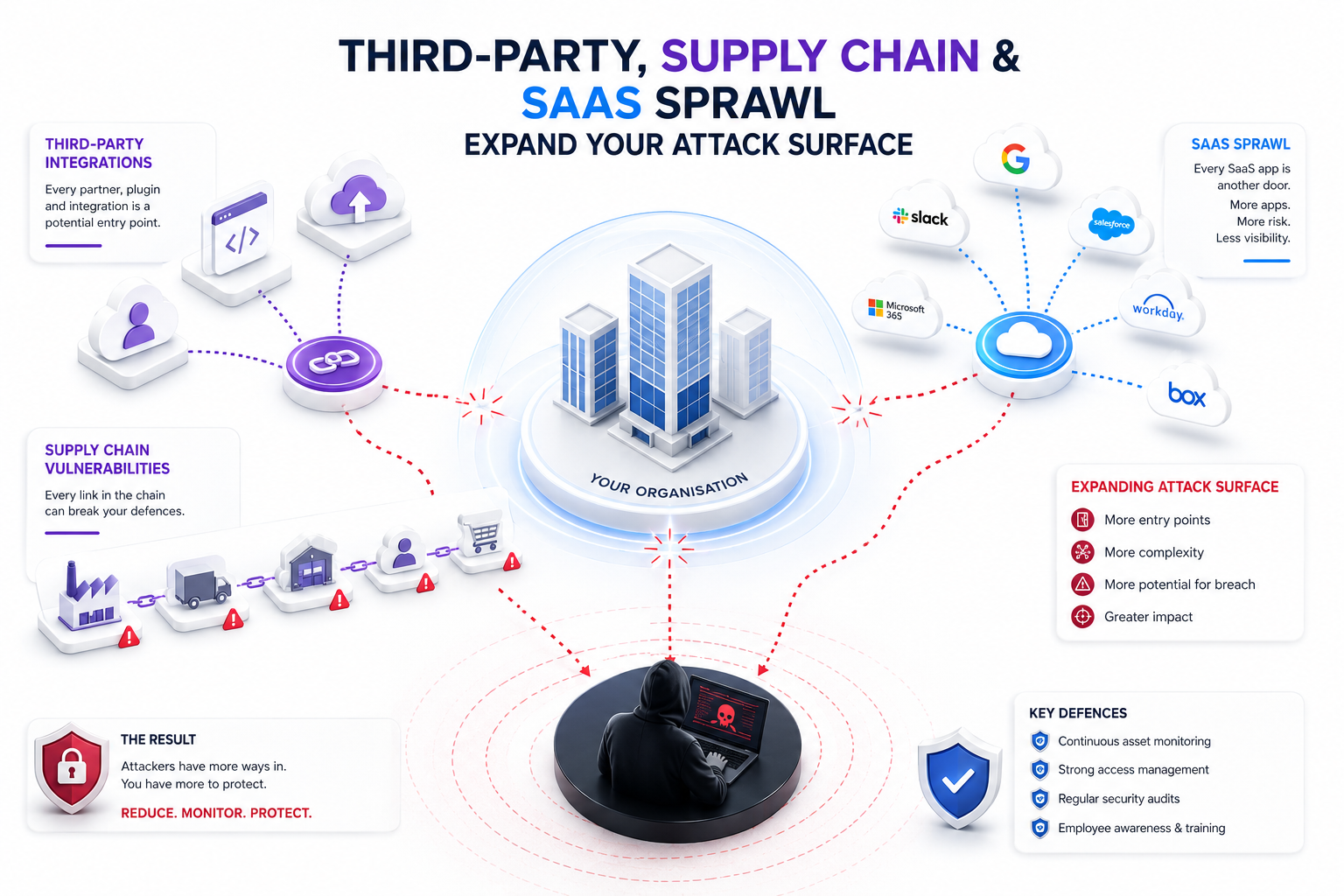
In today’s interconnected digital landscape, businesses rely heavily on third-party vendors, complex supply chains, and Software as a Service (SaaS) solutions. While these relationships are crucial for operational efficiency, they also gift attackers an expanded attack surface. Understanding this complexity is imperative for robust cybersecurity strategies.
Understanding the Attack Surface
Before diving into specifics, let’s clarify what an attack surface is. In cybersecurity, your attack surface includes all the points where an unauthorised user can attempt to enter or extract data from a system. This becomes significantly broader once third-party vendors, supply chains, and multiple SaaS applications are involved.
Third-Party Integrations
With increased collaboration and third-party partnerships, businesses inevitably increase their vulnerabilities. Each third-party service or partner can inadvertently provide a backdoor for attackers, amplifying the possibilities of data breaches and unauthorised access. For comprehensive security, integrating robust third-party monitoring is non-negotiable.
Supply Chain Vulnerabilities
Supply chains are often intricate webs of interconnected systems. Every link introduced increases systemic risk as each vendor potentially exposes you to external threats. This risk is easily illustrated by notorious breaches like the Target data breach, initiated via a third-party HVAC vendor.
To mitigate these risks, Supplier Risk Management tools designed to assess and address vulnerabilities within the supply chain become essential components of cyber defences. These tools provide crucial insights into vendors' cybersecurity postures, allowing businesses to preemptively address weaknesses.
SaaS Sprawl
SaaS platforms provide convenience but come with their own set of challenges. From data storages to user authentications, each application represents additional access points for hackers. Without meticulous tracking and management, SaaS applications contribute significantly to attack surface sprawl.
Implementing asset discovery and monitoring tools can aid in managing this sprawl. These tools assist in identifying unauthorized applications that may bypass existing security protocols.
Strategies for Minimising Attack Surface Expansion
1. Continuous Asset Monitoring
Monitoring tools provide visibility over your digital assets and can alert you to unusual activities or potential threats. Tools like DarkInvader's Asset Monitoring offer invaluable support by safeguarding enterprise networks from expansive attack surfaces.
2. Strong Access Management
Access management solutions are vital for controlling who has access to what. This involves implementing multi-factor authentication, privileged access management, and ensuring strict compliance with the principle of least privilege.
3. Regular Security Audits
Conducting periodic security audits allows businesses to detect system vulnerabilities early. Audits should encompass all third-party, supply chain, and SaaS interactions to ensure comprehensive coverage.
4. Employee Training
Employees are often the weakest link in cybersecurity chains. Regular training on data protection, phishing prevention, and secure application use will empower your workforce to protect organisational digital assets.
Enhancing Cybersecurity Posture
As technology evolves, so too must cybersecurity measures. Beyond standard practices, investing in innovative solutions like DarkInvader's DNS Monitoring and vulnerability scanning provides proactive approaches to address potential threats.
Emphasising collaboration between IT security teams and other departments facilitates a holistic view of potential vulnerabilities and eases the formulation of comprehensive strategies.
Conclusion
The expansion of your attack surface through third-party vendors, supply chain intricacies, and SaaS proliferation is a challenge that demands immediate and ongoing attention. By recognising these vulnerabilities and employing strategic cybersecurity measures, businesses can avert potential disasters.
In an age where digital threats are ever-evolving, protecting your organisation requires an adaptive and vigilant approach. Safeguard your networks, manage your partnerships wisely, and continually refine your strategies. Only then can you maintain a robust defence against cyber threats.
FAQs
What is an attack surface in cybersecurity?
The attack surface refers to all possible points where an unauthorised user might attempt to enter or extract data from a system. This includes network interfaces, applications, and data exchanges, especially those involved with third parties and SaaS offerings.
How do third-party vendors increase attack surfaces?
Third-party vendors can create additional vulnerabilities as they often have access to your systems. If a vendor lacks robust cybersecurity practices, they could inadvertently provide a gateway for attackers.
Why is SaaS sprawl a concern for businesses?
SaaS sprawl involves the use of multiple, often unmonitored, SaaS applications across an organisation. Without proper management, these applications can bypass existing security measures and create additional vulnerabilities.
How can we manage cyber risks associated with supply chains?
Utilizing supplier risk management tools and regular security audits can assist in identifying and mitigating potential vulnerabilities within the supply chain, ensuring all parties adhere to robust security standards.