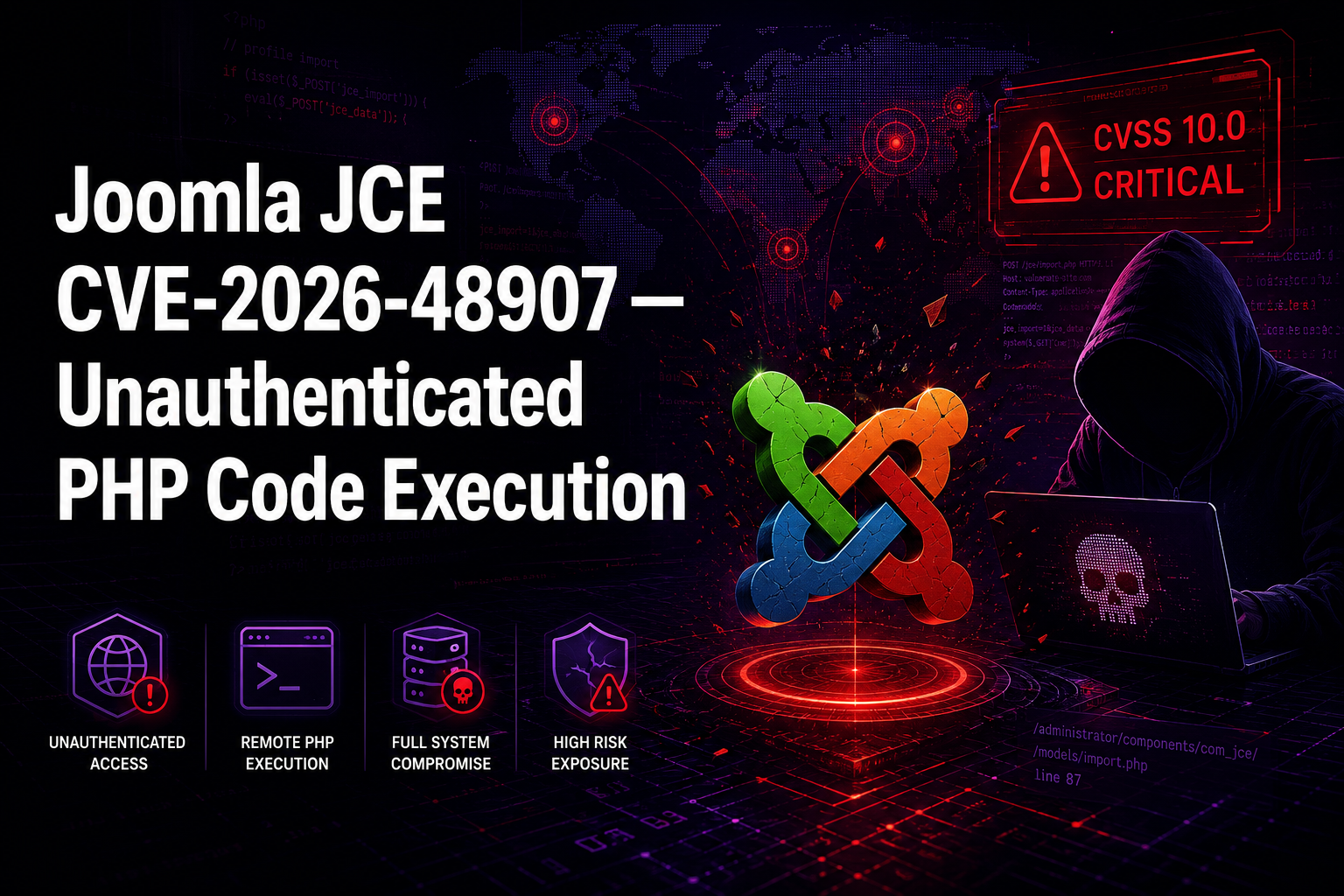
In the competitive world of web security, staying ahead of threats is crucial. Recently, the Joomla JCE CVE-2026-48907 vulnerability emerged as a significant concern for users of the Joomla content management system (CMS). This post delves into the details of this vulnerability, its implications, and how organisations can safeguard against it.
Joomla JCE CVE-2026-48907 is a high-severity vulnerability affecting versions JCE 1.0.0 to 2.9.99.4 of Joomla. It permits unauthenticated attackers to execute PHP code remotely, potentially leading to a complete takeover of the affected website.
The vulnerability resides in the profile-import endpoint of the Joomla JCE, enabling attackers to inject malicious scripts. By exploiting this flaw, cybercriminals can deploy web shells, gaining further control over compromised systems.
With a CVSS score of 10.0, the impact of this vulnerability is considered critical. Unpatched systems are at significant risk of being compromised, jeopardising sensitive data and integrity.
The Joomla team has released patches addressing this vulnerability in versions 2.9.99.5, 2.9.99.6, and 2.9.99.7. Administrators should prioritise applying these patches without delay to mitigate potential risks.
Performing regular security audits can help identify weaknesses and ensure that patches are applied consistently.
Unmanaged and forgotten CMS instances are vulnerable to exploitation. Identifying and managing these shadow elements is crucial in reinforcing the security posture of any organisation.
The External Attack Surface Management (EASM) solutions offered by DarkInvader are effective in identifying and mitigating such vulnerabilities.
Utilising specialised cybersecurity services can provide the experience and knowledge needed to tackle vulnerabilities like Joomla JCE CVE-2026-48907 effectively.
Joomla JCE CVE-2026-48907 underscores the importance of vigilance in web security. Unauthenticated PHP code execution can lead to devastating consequences if left unchecked. Thus, applying patches, conducting regular audits, and engaging with expert security services are paramount.
A high-severity vulnerability that allows unauthenticated PHP code execution on affected Joomla systems, leading to potential full compromise.
Applying the latest patches promptly, conducting security audits, and utilising EASM solutions like those from DarkInvader can effectively mitigate the risk.
External services provide valuable threat intelligence and expertise, enhancing an organisation's capability to detect and respond to vulnerabilities.
By understanding the risks and implementing robust defensive measures, organisations can safeguard against significant security threats like Joomla JCE CVE-2026-48907.

Unlock full visibility of your external attack surface with DarkInvader’s continuous, real-time monitoring. Create your free account to discover unknown assets, detect emerging risks and stay ahead of potential threats before attackers can exploit them.
Create My Free Account
Platform 7D, New Station Street, Leeds,
LS1 4BT, United Kingdom
Mon-Fri, 9:00-17:00
Contact:
sales@darkinvader.io
+44 (0)1138805336
Last updated: 14 August 2026
©2026 DarkInvader, All Rights Reserved


