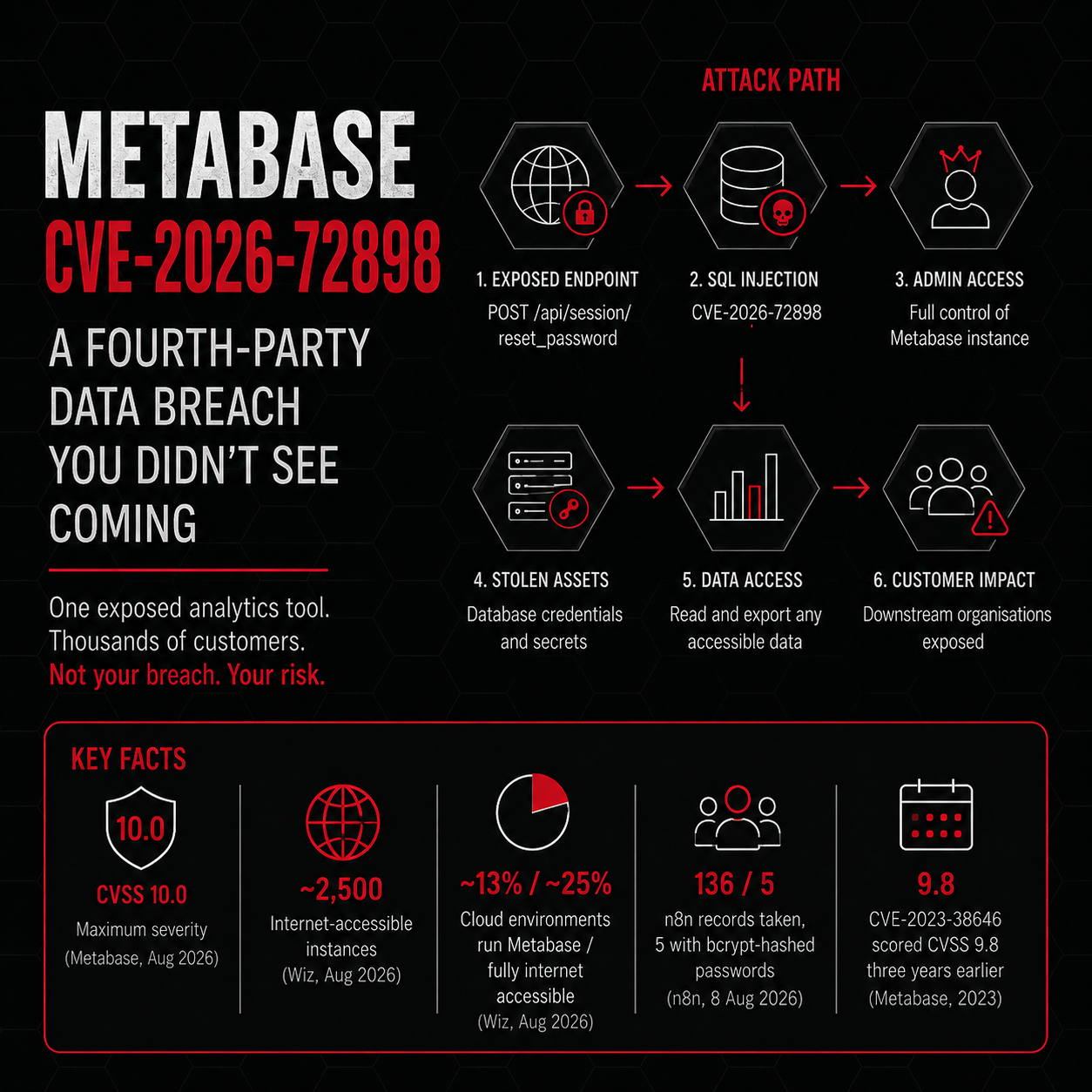
In the intricate web of today's digital ecosystem, businesses often rely on numerous external services to streamline operations and support growth. This reliance, however, brings its own set of risks, with data breaches being at the forefront. When discussing data breaches, one may think about direct threats to businesses or mishandlings by third-party vendors. Yet, an often-overlooked aspect is the risk associated with fourth-party providers. Let's delve into the anatomy of a fourth-party data breach, exploring the role of Metabase, Framework, and n8n in this complex scenario.
A fourth-party data breach occurs when a third-party service provider, subcontracted by the original vendor companies rely upon, encounters a security failure. These breaches can reverberate throughout the supply chain, affecting the original company and its clients. Unlike third-party breaches where direct vendor risk assessments might offer some control, these breaches often remain hidden till a significant incident unfolds.
Metabase is an open-source data analytics tool that simplifies data querying and visualization, making it accessible even to non-technical individuals within a company. Think of it as a bridge that connects raw data with meaningful insights. However, this ease of access can also be a vulnerability. An unsecured Metabase instance can expose sensitive business data to compromised external access.
Frameworks are integral to application development. They provide a structured environment for developers to build, deploy, and maintain applications efficiently. The very frameworks that simplify coding can, however, harbour vulnerabilities themselves. Known security gaps in frameworks might be exploited, leading to fourth-party breaches.
n8n is a popular workflow automation tool that enables integrations across various applications. Its adaptiveness is its strength, allowing businesses to automate tasks and processes effortlessly. This openness, however, also presents a risk factor. Improperly secured APIs or token leaks within n8n workflows can lead to unintended data exposure or breaches.
Imagine a scenario where a company uses Metabase for insights, adopts a popular framework for their applications, and employs n8n for automation. Here’s how a breach might occur:
To secure against such breaches, companies need to invest in comprehensive monitoring tools. Continuous inspection of data flows, access logs, and anomaly detection can preemptively flag suspicious activities.
Conducting regular security audits of all third-party and fourth-party software can help identify obsolete components or unseen vulnerabilities. Ensuring that all software, particularly frameworks and dependent libraries, are consistently updated reduces exposure to known exploits.
Implementing strong encryption methods and securing APIs with authentication and access tokens are pivotal in maintaining data integrity and privacy across n8n workflows.
In today’s interconnected world, understanding and mitigating risks associated with external service dependencies is paramount. Fourth-party data breaches, though less recognised, pose significant threats to organisational data privacy and security. A proactive approach featuring vigilant monitoring, regular system audits, and rigorous security measures can significantly curtail the associated risks.
What is a fourth-party data breach?
A fourth-party data breach occurs when a security failure happens at a vendor's vendor, indirectly affecting the primary business entity that initially contracted the vendor.
How can Metabase contribute to data breaches?
Metabase can lead to data breaches if its instances are inadequately secured, allowing outside parties to access sensitive data visualisations without proper authentication.
What measures can secure n8n workflows?
Securing n8n workflows involves utilising strong encryption, authenticating APIs, and regularly assessing access controls to ensure only authorised interactions.
Why are frameworks a risk in cybersecurity?
Frameworks are a risk because any vulnerability within them can be a potential entry point for attackers, often leading to broader system-wide compromises if not promptly addressed.

Unlock full visibility of your external attack surface with DarkInvader’s continuous, real-time monitoring. Create your free account to discover unknown assets, detect emerging risks and stay ahead of potential threats before attackers can exploit them.
Create My Free Account
Platform 7D, New Station Street, Leeds,
LS1 4BT, United Kingdom
Mon-Fri, 9:00-17:00
Contact:
sales@darkinvader.io
+44 (0)1138805336
Last updated: 14 August 2026
©2026 DarkInvader, All Rights Reserved


