In the realm of cybersecurity, phishing campaigns continuously evolve, finding innovative ways to breach even the most secure systems. The "Payroll Pirates" adversary-in-the-middle (AitM) phishing campaign represents a significant threat, especially to finance-related email boxes. This article explores the techniques used in this campaign and offers practical guidance for detection and defense.
The Payroll Pirates campaign is a sophisticated attack vector that has attracted the attention of cybersecurity professionals globally. It specifically targets Microsoft 365 (M365) accounts, bypassing multi-factor authentication (MFA) and enabling attackers to infiltrate finance and payroll email boxes. According to Arctic Wolf Labs, this campaign has tactical overlaps with Microsoft's Storm-2755 cluster.
Traditional phishing attacks are often blocked or mitigated by MFA. However, AitM phishing cleverly circumvents this layer of security. By acting as a middleman, the phishing kit intercepts the authentication tokens generated during MFA verification, granting attackers access to protected accounts.
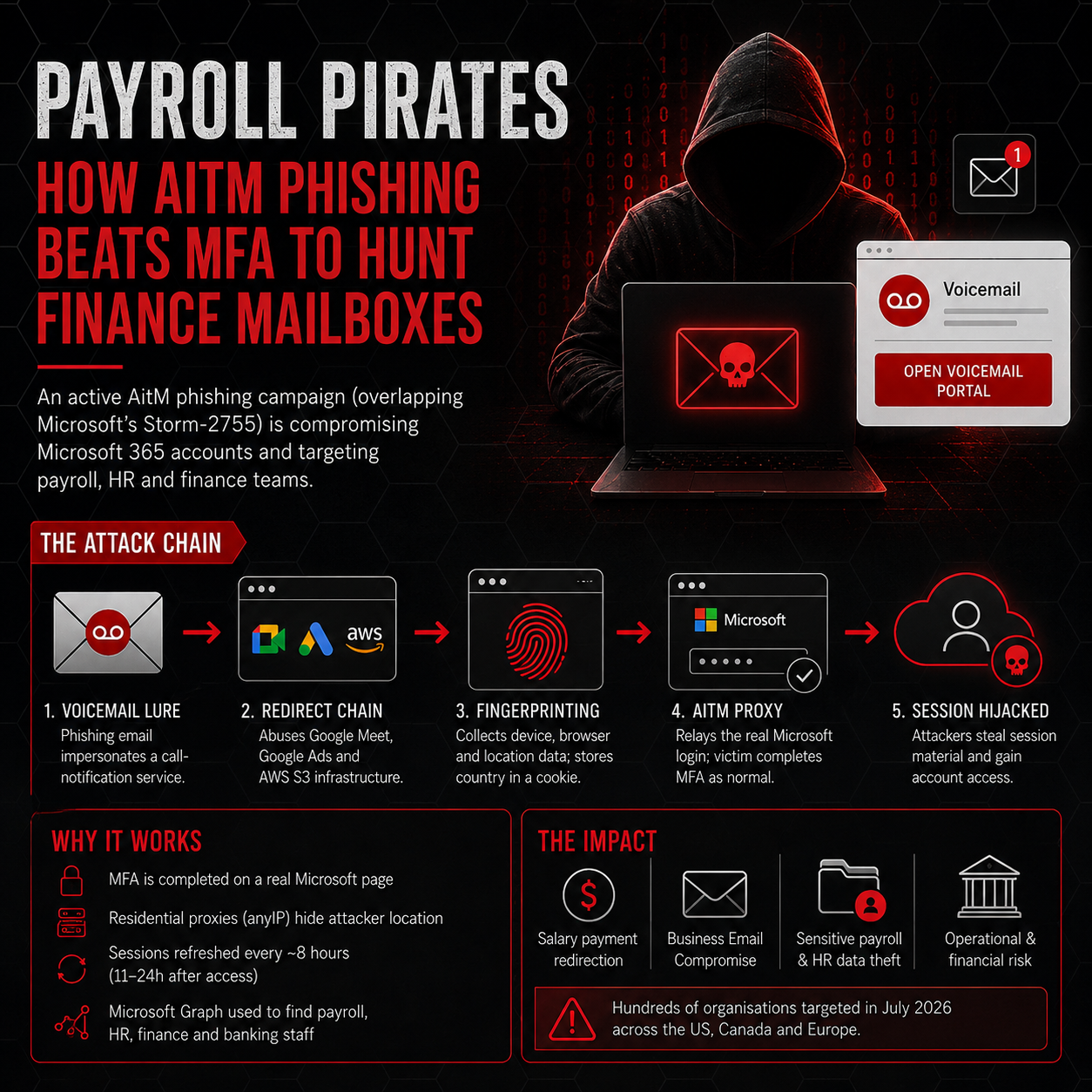
It begins with a voicemail-themed phishing email, enticing the victim with an authentic-looking "OPEN [Organisation] VOICEMAIL PORTAL" button. Upon clicking, victims encounter a multi-stage redirect chain utilizing Google Meet, Google Ads, and AWS S3 infrastructure. These redirects camouflage the real intent of the phishing attempt.
The AitM proxy relays real Microsoft login pages, giving victims a false sense of security. Meanwhile, attackers intercept the session material, which could be used to gain unauthorized access to valuable email boxes.
Residential proxies are used to mask the origin of the login attempts, bypassing impossible-travel and reputation controls. The attackers refresh sessions every eight hours to evade detection and keep their access consistent, with automatic changes in IP address, ASN, and geographical location.
These mailboxes are goldmines for attackers, containing sensitive financial information that can be manipulated for direct financial gain, such as rerouting salary payments or stealing banking credentials.
Implementing phishing-resistant authentication and stringent session anomaly detection are fundamental. Key signals such as suspicious OfficeHome sign-ins or unusual device/browser combinations should be actively monitored.
Organisations should continuously monitor for newly registered domains that impersonate their login pages. Early detection through Brand and DNS monitoring helps mitigate potential phishing lures.
The Payroll Pirates campaign is a stark reminder that cybersecurity requires constant vigilance, adaptation, and awareness. Recognising and responding to these phishing tactics can significantly reduce the risk of financial loss and reputational damage.
Payroll Pirates is known for its cunning phishing techniques that target finance-related email boxes, often bypassing conventional MFA defenses.
Yes, it intercepts the MFA tokens, allowing attackers undetected access to accounts.
Signs include suspicious sign-ins, odd geographical login origins, and errors such as authentication error 90014.
Residential proxies mask the attacker’s origin, making it harder to trace the source of login attempts.
Organizations across sectors like healthcare, education, manufacturing, and government are key targets, particularly in North America and Europe.
Employing a robust combination of authentication methods, anomaly detection, and using external services to continuously monitor potential exploits is essential.
Publishing and promoting awareness of phishing methods like Payroll Pirates is vital for cybersecurity resilience.

Unlock full visibility of your external attack surface with DarkInvader’s continuous, real-time monitoring. Create your free account to discover unknown assets, detect emerging risks and stay ahead of potential threats before attackers can exploit them.
Create My Free Account
Platform 7D, New Station Street, Leeds,
LS1 4BT, United Kingdom
Mon-Fri, 9:00-17:00
Contact:
sales@darkinvader.io
+44 (0)1138805336
Last updated: 14 August 2026
©2026 DarkInvader, All Rights Reserved


