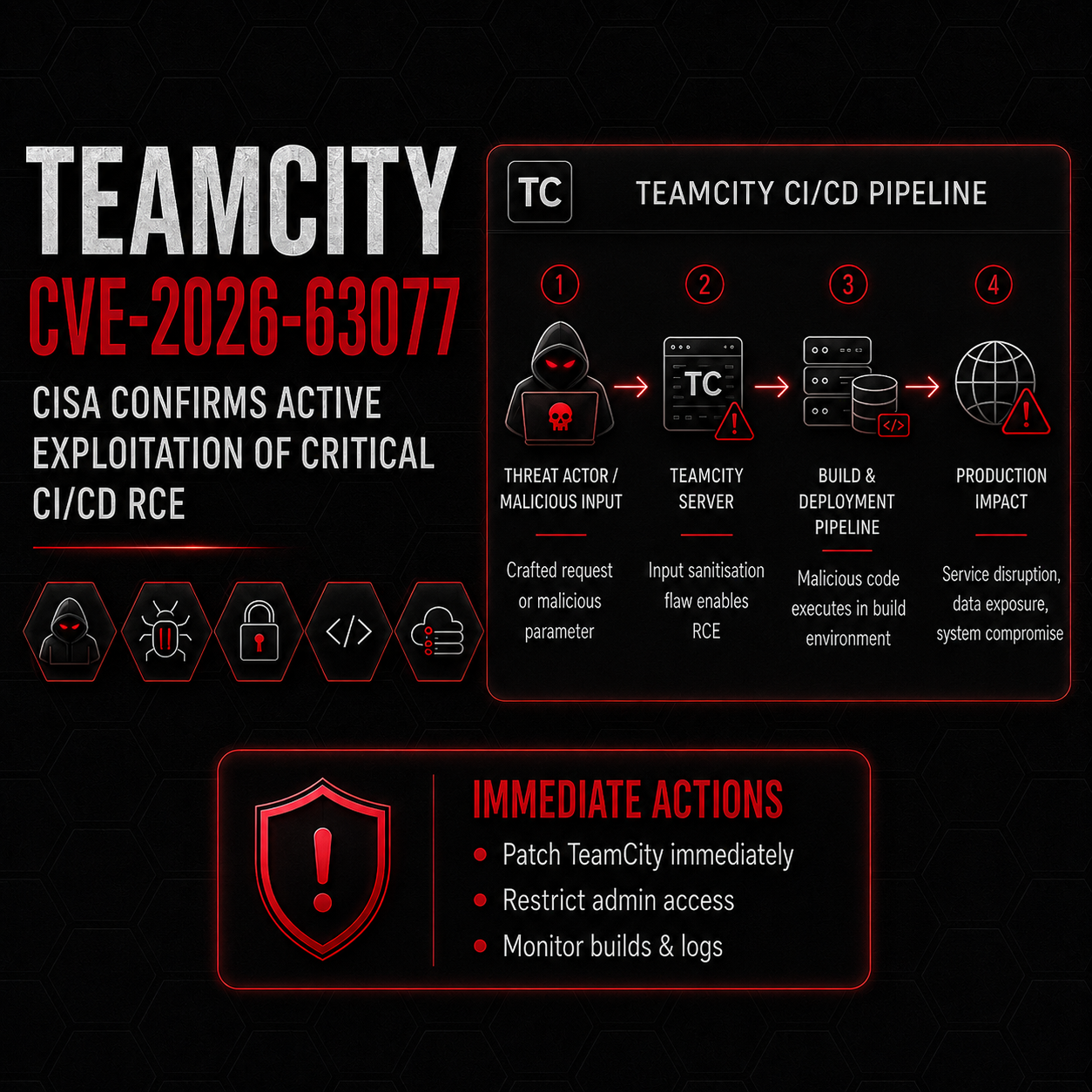
In the ever-evolving landscape of cybersecurity, vulnerabilities can appear and escalate rapidly. One such recent vulnerability that has caught the attention of security experts worldwide is CVE-2026-63077, affecting JetBrains TeamCity – a widely-used continuous integration and continuous deployment (CI/CD) platform. The Cybersecurity and Infrastructure Security Agency (CISA) has confirmed that this vulnerability is actively being exploited, making it a critical concern for organisations relying on TeamCity in their software development pipeline.
CVE-2026-63077 is a critical remote code execution (RCE) vulnerability that lurks within certain versions of JetBrains TeamCity. This vulnerability potentially allows malicious actors to execute arbitrary code on affected systems, compromising the integrity, confidentiality, and availability of sensitive data and operations managed through TeamCity.
The facilitated exploitation is due to inadequate input sanitisation mechanisms within the affected TeamCity versions. Cybercriminals can manipulate inputs to inject malicious scripts or commands, thereby gaining unauthorised access and escalating privileges within the affected CI/CD environments.
This presents a significant threat, particularly as CI/CD pipelines are crucial in automating software releases, where trust and security are paramount. For a deeper dive into vulnerability scanning in software environments, visit our vulnerability scanning page.
CISA has taken an active role in monitoring the exploitation of CVE-2026-63077. By collaborating with cybersecurity researchers and industry partners, CISA's efforts aim to mitigate these threats by publicising tactics, techniques, and procedures (TTPs) associated with this vulnerability. Their role is pivotal in guiding organisations on how to secure their environments against such critical threats.
The active exploitation of CVE-2026-63077 signifies a broader concern within the cybersecurity domain, especially for businesses heavily reliant on CI/CD operations. A breach can halt deployments, manipulate codebases, or even introduce backdoors into production environments. As the software lifecycle accelerates, the consequences of compromised development infrastructure can be severe.
Damage to reputation, loss of intellectual property, and possible legal ramifications due to customer data exposure are a few of the commercial risks associated with this vulnerability. Organisations must anticipate and proactively defend against such risks, ensuring their competitive position in the market remains uncompromised.
The revelation of CVE-2026-63077 and its active exploitation confirmed by CISA highlights a pivotal reminder of the constant threats lurking in our digital infrastructure. As cybersecurity professionals strive to safeguard technological assets, organisations must respond diligently by updating, monitoring, and securing their CI/CD environments. Leveraging insights from reputed vulnerability scanners and remaining informed through threat intelligence (as offered by DarkInvader), can significantly bolster your defence mechanisms.
CVE-2026-63077 poses a significant threat by allowing attackers to execute arbitrary code, potentially leading to unauthorised access and manipulation of the CI/CD pipeline, which can disrupt software deployment processes.
To protect your organisation, ensure that your TeamCity installation is updated to the latest version, enhance your monitoring capabilities, enforce stringent access controls, and have a robust incident response plan in place.
Addressing the CVE-2026-63077 vulnerability promptly is crucial to prevent potential data breaches, maintain trust with customers, protect intellectual property, and avoid business disruptions that could result from compromised software deployments.
DarkInvader provides comprehensive tools such as asset monitoring and OSINT monitoring, equipping organisations with the intelligence needed to identify and respond swiftly to vulnerabilities like CVE-2026-63077. Visit our Website Takedowns page for more information.

Unlock full visibility of your external attack surface with DarkInvader’s continuous, real-time monitoring. Create your free account to discover unknown assets, detect emerging risks and stay ahead of potential threats before attackers can exploit them.
Create My Free Account
Platform 7D, New Station Street, Leeds,
LS1 4BT, United Kingdom
Mon-Fri, 9:00-17:00
Contact:
sales@darkinvader.io
+44 (0)1138805336
Last updated: 14 August 2026
©2026 DarkInvader, All Rights Reserved


