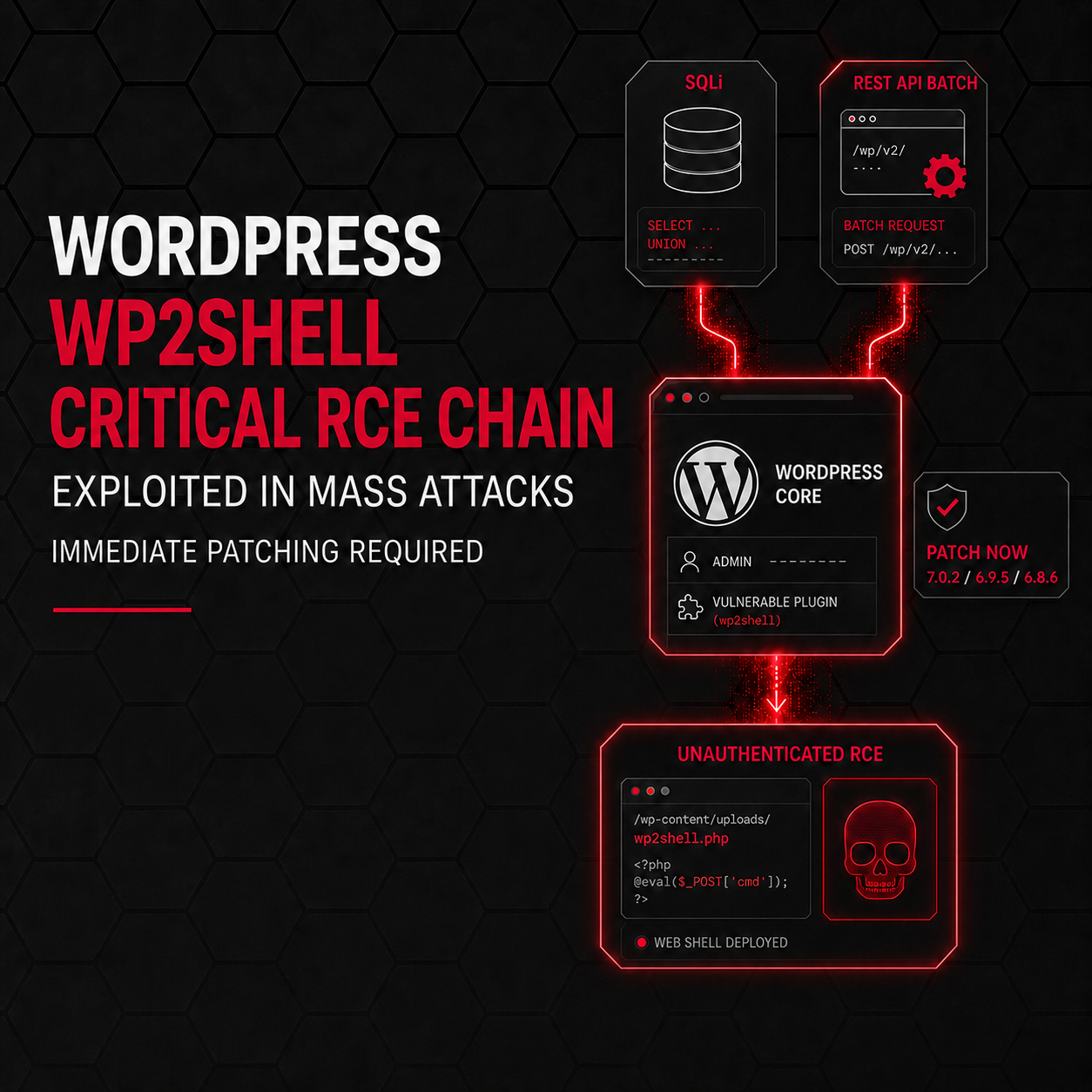
WordPress, powering approximately 43% of all websites globally, is a cornerstone of the internet. However, its prevalence makes it a prime target for exploitation. Recently, the discovery of a critical Remote Code Execution (RCE) vulnerability chain known as "wp2shell" has put millions of WordPress sites at risk. This blog explores the nature of these vulnerabilities, how they have been exploited in the wild, and the critical steps site administrators must take to safeguard their sites.
WordPress’ widespread use means a flaw in its core can have potentially devastating impacts across the internet. The wp2shell vulnerability doesn't require plugins or special configurations to be exploited, making it exceptionally dangerous. It involves two main vulnerabilities: CVE-2026-63030 and CVE-2026-60137.
This flaw involves SQL injection within WordPress Core, allowing attackers to manipulate database queries without authentication. Such a vulnerability enables an attacker to modify or access sensitive data, which, when combined with other exploits, can lead to full system compromise.
A logic flaw within the REST API’s batch processor allows for code execution without proper validation. This defect separates validation from execution, permitting malicious requests to bypass security checks, leading to unauthorized code execution.
The combination of the SQL injection and the REST API flaw facilitates unauthenticated RCE on WordPress installations. Attackers can manipulate the database through SQL injection and use the batch processor flaw to execute arbitrary code, affecting any default installation from versions 6.8 to 7.0.1.
The vulnerabilities were publicly disclosed on July 18–19, 2026. Within hours, exploitation began, with public proof-of-concept exploits being shared widely. WordPress responded on July 19 by releasing patches for versions 6.9.5, 7.0.2, and 6.8.6. Despite this rapid response, the scale of unpatched sites resulted in significant exploitation attempts globally within a day.
Several IP addresses across countries like Switzerland, Germany, and Singapore were linked to exploitation efforts, deploying persistent web shells and creating backdoor accounts. Monitoring networks recorded tens of thousands of attack attempts, underscoring the urgency of an immediate patch.
Once attackers achieve RCE, they often proceed with:
Admins should look for signs such as:
WordPress implements forced auto-updates for affected versions if auto-updates are enabled. Administrators must check their dashboard to ensure their site runs on a patched version, as manual updates might be necessary otherwise.
While patching is the ultimate solution, temporary measures include:
Organisations must engage in continuous validation to identify unpatched WordPress instances and potential vulnerabilities. Conduct regular audits, simulate attacks to test defenses, and ensure timely patch application. Integrating external asset discovery and monitoring strategies helps in maintaining security across all WordPress deployments.
The WordPress wp2shell vulnerabilities represent a formidable threat due to their accessibility and potential impact. Site administrators must act swiftly to patch these flaws and fortify their defenses. With vigilant monitoring and prompt updates, it is possible to mitigate risks and protect WordPress sites from exploitation.
Do I need plugins installed to be vulnerable?
No, the vulnerability affects the WordPress Core and operates on default installations without plugins.
Am I protected with a persistent object cache?
Partially. While it alters attack conditions, it's imperative to apply patches for complete protection.
Can I detect if my site was compromised before patching?
Check logs, the database for anomalous activities, and file directories for unauthorized changes.
What if I can't apply patches immediately?
Use mitigations like blocking specific endpoints and implementing object caches, but prioritize patching within days.
Should I assume compromise if my site was unpatched?
Yes, if the site remained unpatched during the initial exploitation window, assume compromise and initiate incident response.
Does a hosting provider's auto-update offer protection?
If enabled, auto-updates likely patched your site, but verify the version in your WordPress dashboard to ensure it's updated.

Unlock full visibility of your external attack surface with DarkInvader’s continuous, real-time monitoring. Create your free account to discover unknown assets, detect emerging risks and stay ahead of potential threats before attackers can exploit them.
Create My Free Account
Platform 7D, New Station Street, Leeds,
LS1 4BT, United Kingdom
Mon-Fri, 9:00-17:00
Contact:
sales@darkinvader.io
+44 (0)1138805336
Last updated: 14 August 2026
©2026 DarkInvader, All Rights Reserved


